
From Viana do Castelo, Portugal to Antalya, Viana Ciclável ride within planetary boundaries
A solo, self-sufficient, ~4,700 km expedition to COP31 — and a call to action from Viana Ciclável
Link for fundraising (gofundme)
Help us build a cycling city and pedal 4,700Km to COP31
Link to follow the journey (polarsteps)
https://linktr.ee/Vianaciclavel
Link for fundraising (gofundme)
Help us build a cycling city and pedal 4,700Km to COP31
Link to follow the journey (polarsteps)
https://linktr.ee/Vianaciclavel
The Challenge
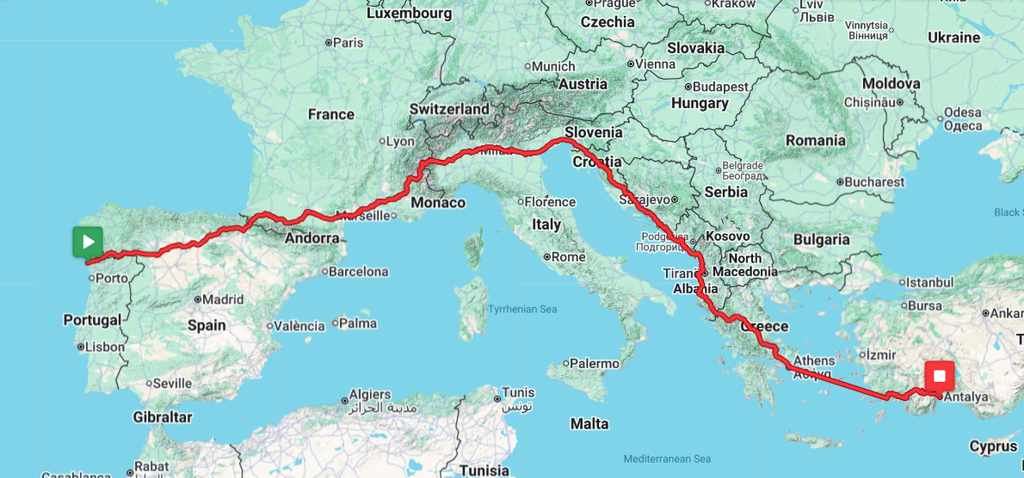
On October 5, David Mendes will set off solo from Viana do Castelo, bound for Antalya, Turkey. Roughly a month later, if all goes according to plan, he will arrive in time for the opening of COP31 on November 9.
Between his starting point and destination lie 4,700 kilometers and 37,000 meters of cumulative elevation gain—the equivalent of climbing Mount Everest more than four times. He will cross eleven countries and take two ferry crossings under a single rule: rely solely on his own effort, with no motorized assistance, no support team—just the bicycle and his legs.
This expedition is a symbolic gesture raising the question: if a regular cyclist can cross an entire continent by pedaling with no assistance, staying within the resource limits of our planet, what stops a city, a country, or an entire system from finding sustainable ways to move?
This encompasses not only bicycles but also land-based transit like trains, buses, and other public transportation systems. Unfortunately, these networks are often inefficient or inaccessible to the public, driving a heavy reliance on cars in cities and on aviation for short-distance travel.
Why This Journey
This expedition stems from a simple, uncomfortable conviction: collectively, we use far more than what the planet can sustain. The transportation system we built over the last century—reliant on fossil fuels, heavy infrastructure, and speed at all costs—is one of the largest drivers of emissions, land use , and inequality in how we move.
The result turned out to be an inefficient mobility that discourages the use of active and healthy modes of transport, transforming cities into congested storehouses of noisy, dirty, and dangerous machines, creating a dehumanized urban environment where children have traded the outdoors for a car seat.
The bicycle is not a thing of nostalgia. It is one of the most efficient transportation technologies ever invented by humans—in terms of energy spent per kilometer, materials needed for manufacturing, urban space occupied, and health returned to those who use it (with an amply positive balance), urban space occupied, and efficiency in mobility.
Shifting our transportation system toward lighter, slower, more human, and more enjoyable methods is not a step backward for civilization. It is likely one of the most realistic transitions within our reach to live within planetary boundaries while preserving the climate and biodiversity that sustain us.
It is also the only way to democratize mobility, rejecting the dictatorship of the car and allowing the inclusive enjoyment of public space by everyone, in freedom, without risking the loss of life that has claimed so many victims—as was the case with Fátima Linhares, killed at age 38 in Barcelos simply for riding a bicycle and Finlay Tarley killed at age 19 due to lack of care towards cyclists. These are just two of the many people who are tragically killed every year in Viana and worldwide.
This is the very change that Viana Ciclável tries to build through community engagement every day on a city-wide scale: community bicycle workshops that teach people how to fix them; the Bike bus program, enabling children to go to school by bike safely, the Bike Buddy program, which accompanies those riding alone for the first time; school programs that teach children from an early age that the bicycle is a legitimate and desirable way to get anywhere; and institutional advocacy with the City Council to ensure safe cycling infrastructure becomes the rule rather than the exception.
This expedition is also the vehicle through which Viana Ciclável aims to reach COP31, partnering with organizations such as COP Bike ride, International Degrowth Network MUBI and other organisations. Together, we aim to bring the voice of active mobility and sustainability to a table where conversations too often focus solely on technology and markets, and rarely on how to live within the limits of our planet right now with the existing technology, such as enabling the use of bicycles.
The institutions and messages
COP BIKE RIDE
A cycling relay that grows every year: 200 cyclists and 6,500 km in 2024 (Paris–Baku), over 1,000 cyclists and 20,000 km in 2025, with a target of 10,000 participants in 2026 spanning Europe, South America, Central Asia and Africa.
The mechanism is simple: a banner carrying 10 concrete cycling policy proposals passes from cyclist to cyclist, city to city, all the way to the COP31 negotiating tables — functioning like an Olympic torch with a political message.
With this expedition we are carrying the commitments from the city of Viana do Castelo in one long trip rather than a relay to the COP31.
Why it matters: transport accounts for roughly 21% of global carbon emissions, yet only one third of national climate plans even mention cycling. The case for action is backed by strong numbers — 75% of urban trips are under 5 km, 42% of city deliveries could be made by cargo bike, and if public transport, walking and cycling covered 80% of urban trips, emissions would be 50% lower.
The commitments of the Viana do Castelo city council and the parishes (juntas de freguesia) are here.
INTERNATIONAL DEGROWTH NETWORK
A global community of individuals, organisations, and degrowth allies committed to creating an equitable and sustainable world for all generations. We’re here to build connections across borders while providing a collaborative space to develop alternative pathways toward a better future.
What is Degrowth? Degrowth suggests shifting away from economic growth as the main measure of society’s success and well-being. The constant pursuit of economic growth at all costs harms the environment, uses up resources, and creates social inequality.
Degrowth asks that we pay attention to other signs of well-being, like quality of life, fairness, access to basic needs and environmental sustainability. To do this, we need to rethink our current economic system, question the idea that economic growth is crucial, and consider different models that put human well-being, autonomy, and ecological health first. This will mean changing how we consume and work and what values our society prioritises.
The International Degrowth Network aims to create a community for like-minded individuals and organisations to work together and create spaces where alternatives can thrive.
In this expedition we will deliver a position paper on the state of Degrowth and relationship to climate change. Riding a bicycle is one of the simplest ways to illustrate degrowth where one benefits from a cheap tool that causes immense happiness, health, equity and well being with little use of resources and pollution. It registers little in economic “growth” but it registers a lot in enhancement of all aspects of human existence and the environment. All this is possible with a technology that is available and ready to be deployed and cause great impact. Less is more. It is not physically possible to keep growing the use of resources and energy in a finite world
The Portuguese Network is Rede para o Decrescimento
MUBI – NGO for urban mobility by bicycle
Public space must belong to everyone and be for everyone. The bicycle is a simple and affordable tool — yet a powerful one for personal and social transformation.
In this expedition we will deliver a manifesto “Manifesto Cidades vivas – 10 measures to give the city back to people at the COP, seeking support for local initiatives. This is a framework for Portuguese municipalities to make a broad and firm commitment to a real paradigm shift in urban and mobility policies, prioritising walking, cycling, public transport, and shared mobility systems, over individual car use. Viana ciclavel produced its own version of the manifesto with “Viana Cidade Viva” subscribed by various political forces in the city.
The Route: Terrain, Mountain Ranges, and Borders
The journey does not take the easy way. It deliberately follows a path through the physical, geographical, and cultural challenges of a Europe (and an Asia Minor) that has not yet decided how it wants to move in the 21st century.
Portugal and Spain — from Atlantic granite to the dry plateau. The first few days are unforgiving. Right after leaving Viana do Castelo, the road climbs into the Peneda-Gerês National Park, crossing into Galicia through the Serra do Xurés. It then continues into the Sanabria mountains up to the Padornelo pass at 1,350 meters. Here, the humid, granitic green of the Iberian northwest gives way in just a few kilometers to the dry, windswept plateau of the Castilian Meseta—a vast plain that must be crossed entirely before reaching Pamplona at the foot of the Pyrenees.
The Pyrenees and the Alps — Europe’s two great natural walls. The Pyrenees are not just a mountain range; for centuries, they have stood as the cultural and linguistic border separating the Iberian Peninsula from the rest of the continent. The route consciously crosses them, climbing over it in a single day to Saint-Jean-Pied-de-Port—a historic crossing point for pilgrims. However, it is in the Alps, the second great wall of the journey, where the expedition faces its most physically grueling moment. “after the Col de l’Échelle on the way to Embrun, the alpine crossing to Chivasso rises to 1,762 meters. The route cuts through territory where the Franco-Italian border has repeatedly shifted over the centuries—bringing thin air, temperatures that may already hint at winter, and kilometers of relentless climbing.
The Balkans — Dinaric karst and the mosaic of post-Yugoslav borders. From Croatia to Greece, the route deliberately bypasses the tourist-heavy coast to dive into the Dalmatian interior. This is a landscape of limestone karst, where water vanishes underground only to reappear in lakes like Imotski, and where cities like Knin carry the memory of borders that have shifted multiple times in the last three decades alone. After skirting the Bay of Kotor, the route successively crosses Montenegro and Albania—two countries that, until recently, were among the most isolated and least friendly for bicycle tourism in all of Europe. Passing through Gjirokastër, a UNESCO-listed stone city, the route reaches the true heart of the expedition: the Katara pass at 1,705 meters in the Pindus range. This mountainous backbone historically separated Epirus from Thessaly and isolated entire communities of transhumant shepherds for centuries. Standing as the highest point of his journey through eastern Europe, the reward is immediate: the descent leads straight to Meteora, where Byzantine monasteries have balanced atop sandstone pillars for seven hundred years.
The Aegean Crossing — a break, but not a rest. From Piraeus to Rhodes, and Rhodes to Marmaris by ferry—this is the only part of the journey where the cyclist does not pedal, yet the logistics require as much focus as any mountain pass. Boarding schedules and same-day connections mean that a single planning error here costs days that the calendar simply cannot spare. Symbolically, it is also the border between Europe and Asia—and between Greek and Turkish, marking the final linguistic and alphabetical leap of the trip.
Turkey — the Taurus plateau and the final push. After Marmaris, the route deliberately avoids the easier but busier coastal road to climb toward the Elmalı plateau in the Taurus Mountains. This geological barrier has separated the Anatolian interior from the coastal civilizations of Lycia and Pisidia since antiquity, and it still isolates entire villages from the rest of the country today. It is a remote territory carved by gorges like Saklıkent, where most tourists never set foot and where the expedition depends entirely on its own self-sufficiency between distant villages. Here, in the final days, with legs already carrying nearly a month on the road, the expedition will decide whether or not it arrives on time. The final stage descends into Antalya via Termessos, an ancient city that even Alexander the Great did not dare to attack.
Every border means much more than a passport stamp or a customs post: it means changing language, culture, religion, and alphabet. Along the way, the journey will venture into truly remote territory. Across the inland plateaus of the Balkans and Anatolia, villages are scarce, mobile networks fail, and self-sufficiency shifts from an abstract principle into a practical necessity. Water, food, and shelter must be planned well in advance because a second chance of supply is rarely just a few kilometers away.
COMPROMISSO a assinar pelo município / juntas / CIM a ser entregue na COP + LOGO VIANA Ciclável
As nossas 10 propostas nas COPs para alavancar o ciclismo na proteção do clima
A subscrever por: Países, regiões, municípios e freguesias.
As 10 Propostas
- Structural Cycling Network (2030 Goal))
- Complete a basic structural network of bike lanes until 2030.
- especially with inter-town AND multimodal connectivity for daily journeys.
- If the base is already in place, make it ambitious !
- Decrease car traffic
- Decrease car traffic by limiting both speed and volume.
- Eliminate deaths and serious injuries from road accidents by 2030 – vision zero!
- Dedicated Strategic Plans
- Develop specific plans by 2030, covering all possible levers for the development of bicycle use.
- Ensure adequate and dedicated funding.
- Develop implementation reviews that include bicycle user associations and collectives.
- Exclusive Pedestrian and Cycling Zones
- Significantly increase exclusive areas for bicycles and walking by 2030.
- Focus implementation near schools, public transport hubs, local commerce, and green areas.
- Expanded Parking and Storage
- Generalize adequate bicycle storage capacity by 2030.
- Cover transport hubs, commercial areas (!), schools, offices, and homes.
- Mandatorily include space for cargo bikes.
- Mass Events and Community Infrastructure
- Develop a schedule and venue for cycling and bicycle use.
- Create an annual mass cycling and/or bicycle use event, for all ages, promoting broad public participation.
- Implement a “bike house” for repairs, training, gatherings, and hosting.
- Empowerment, Training, and Financial Literacy
- Train and inform: empower, especially those under 12 and women, for more efficient and empowering bicycle use.
- Promote the financial benefits of this mode of transport (the annual cost of a car is ten times higher!).
- Boosting the Cycling Economic Sector
- Develop the associated economic sector (services, manufacturing, leasing, sharing…).
- Implement this expansion through specific tax incentives and subsidies.
- Urban Logistics and “Last Mile” Deliveries
- Develop cargo bike logistics for “last mile” deliveries.
- Supporting note: A recent study shows that 42% of deliveries made by utility vans could be done using cargo bikes.
- Indicators and Regular Monitoring
- Implement and regularly disclose indicators to measure and monitor progress.
- Assess metrics on satisfaction, accidents, size of the dedicated network, and intermodal integration.
Portugal Coordination
- E-mail: ecomood.portugal@gmail.com
- Linktree Oficial: https://linktr.ee/ecomoodportugal